

Digital Marketing Audits
What Does a Digital Marketing Audit Service Actually Include?
If you are searching for a digital marketing audit service, there is usually a reason. Something does not add up.
Maybe marketing spend has climbed while revenue has not. Maybe an agency report looks healthy, but the CRM tells a different story. Maybe SEO traffic is growing and leads are not. Or maybe leadership simply wants someone outside the day-to-day marketing operation to review the work before making a bigger decision.
The problem is that marketing audit can describe very different things. One provider may mean a short sales call. Another may run a website through an automated tool and send back a score. A deeper independent audit can involve paid media, SEO, website performance, reporting, agency or internal team execution, costs, lead quality, and available revenue data.
If you are still deciding whether an audit is even the right step, start with What Is a Digital Marketing Audit and When Does Your Business Need One?.
A marketing audit should start with the business, not the platforms
It is easy to start with a checklist of Google Ads settings or SEO errors. That is not where the most useful audits begin. The first questions are more basic: What are you spending? What is the business trying to generate? What counts as a good lead? Who manages each part of the marketing? What are you being told is working? What do sales, CRM, and revenue records show?
Without that context, an auditor can find technical imperfections and still miss the bigger issue. A campaign can be technically tidy and still be a poor business investment.
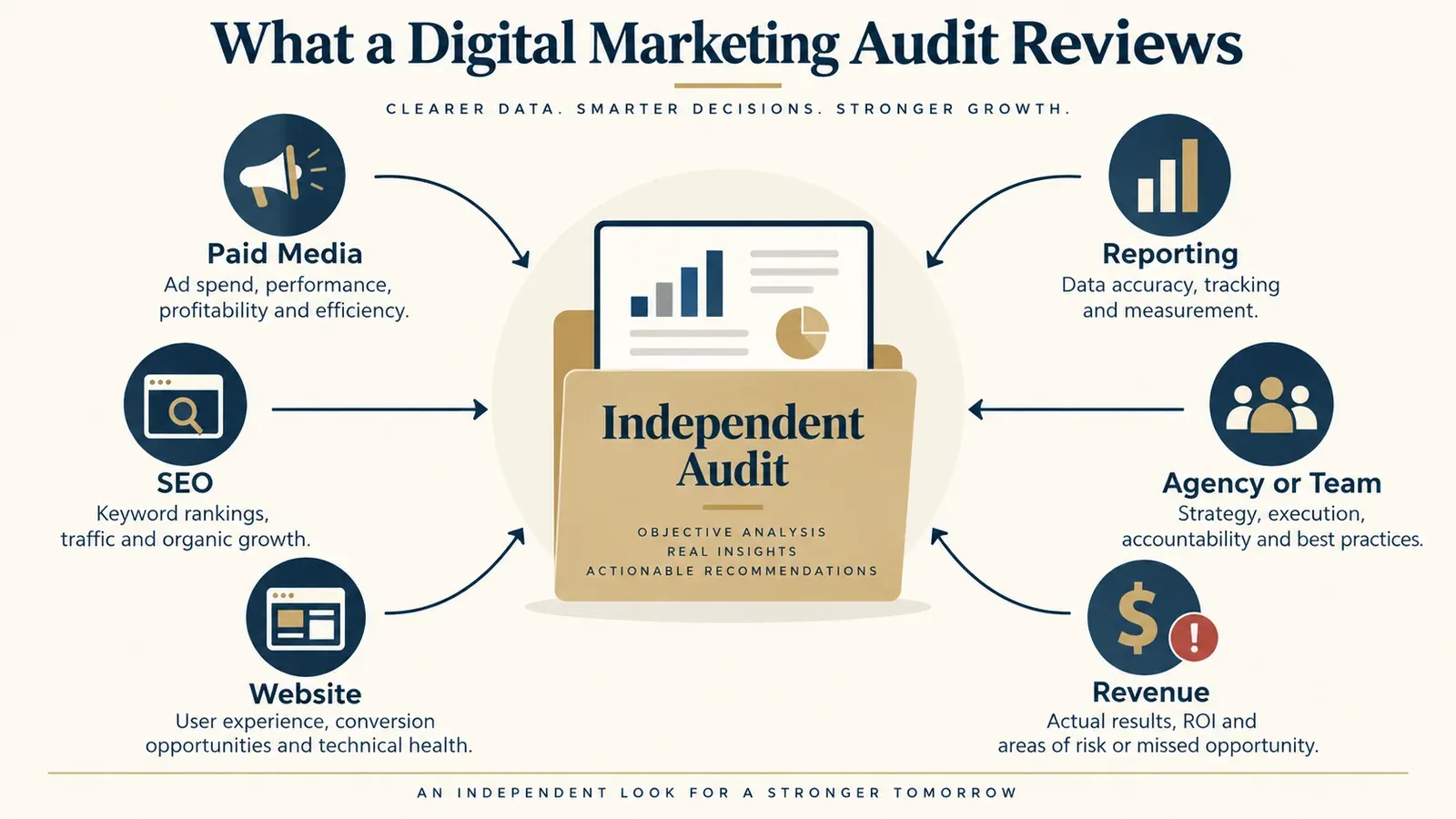
1. Marketing spend and cost analysis
A useful audit should establish where the money is actually going before judging whether the marketing is efficient. That can include ad spend, agency fees, SEO retainers, software, landing pages, email or SMS tools, freelancers, and other recurring marketing costs.
The goal is not to label something expensive simply because the number is large. The better question is whether the cost makes sense relative to what the business is receiving.
Real paid search audit example
In one home services account reviewed for May through August 2026, all Google campaigns produced $436,555.72 in completed revenue against $259,280.95 in ad spend plus an estimated PPC management fee: a 1.68x revenue multiple before overhead or job costs. That top-line number hid very different results underneath. The two Performance Max campaigns were at 0.63x. Brand keyword rows were at 1.83x. Nonbrand keyword rows were at 0.48x.
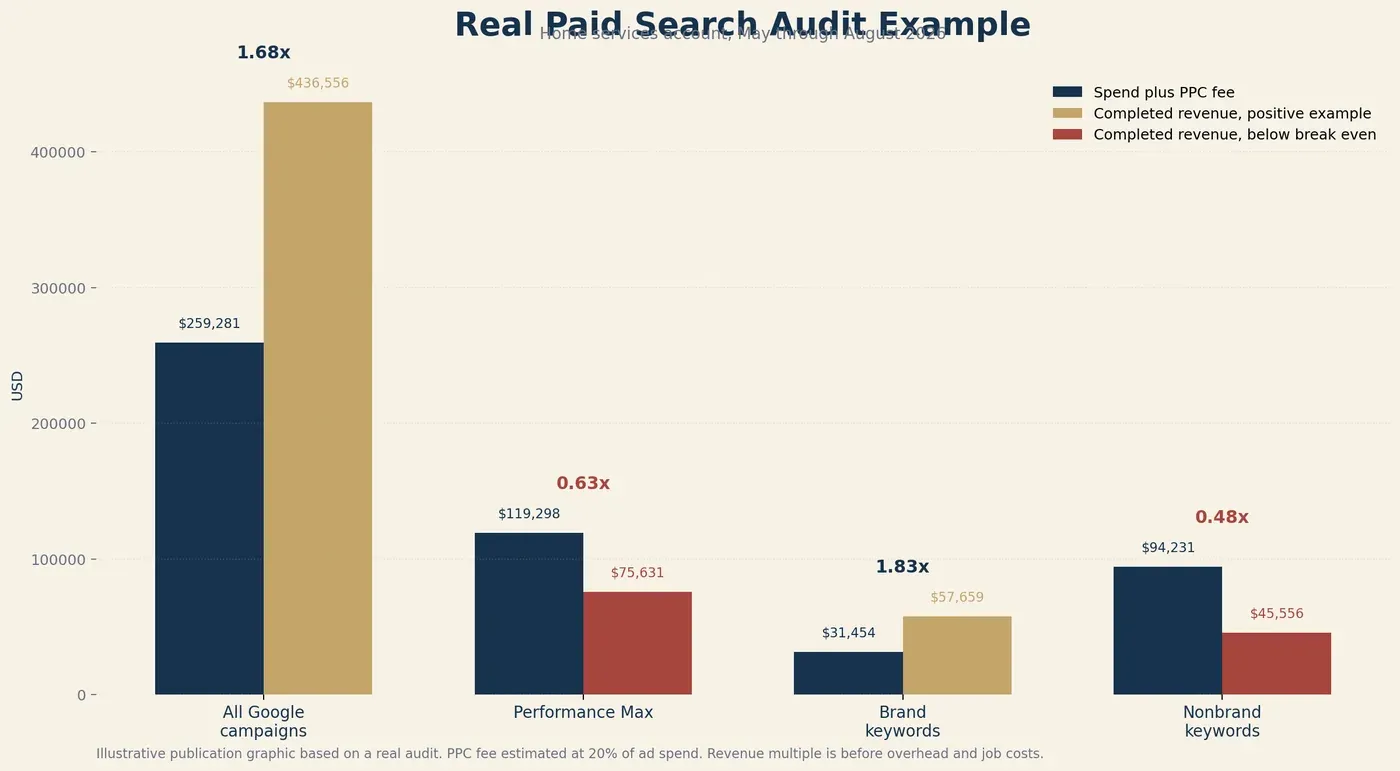
Real audit data, client name omitted for publication. PPC fee estimated at 20% of ad spend. Figures are before overhead and job costs.
2. Paid media performance
If paid search is part of the scope, the audit should go beyond the headline numbers in the dashboard. Google Ads may need to be reviewed at campaign, search term, conversion, budget, bidding, location, landing page, and change-history level.
For a deeper service-specific review, see Google Ads Audit.
One of the most important distinctions is between a platform conversion and a business result. A conversion might be a form submission, a phone call, a button click, a repeat customer, an unqualified lead, or a duplicated event.
Related reading: Why Google Ads Conversions Do Not Match Your Actual Sales and How Digital Marketing Conversions Get Double Counted.
3. SEO performance
An SEO audit should look at more than a ranking report. Search visibility, Google Search Console data, technical health, indexation, content quality, internal linking, backlinks, local search, and traffic quality can all matter.
If an outside SEO agency is involved, the audit should also compare what was promised with what can actually be verified. More traffic is not automatically better SEO if the traffic is irrelevant or never turns into business.
See SEO Traffic Is Up. Why Are Leads Down? for a closer look at that problem.
4. Agency or vendor performance
For businesses using an outside agency, a marketing agency audit may include account ownership, administrative access, fees, contract deliverables, work completed, reporting methodology, conversion setup, lead quality, and revenue claims.
This does not mean the agency is assumed to be doing poor work. Sometimes the result of an independent review is that the agency is doing exactly what it should be doing. The point is to verify the work instead of asking the same company doing the work to be the only source evaluating it.
If you want a more detailed agency checklist, read How to Audit a Digital Marketing Agency.
5. Reporting and revenue
Reporting is where several different systems often collide. A Reporting and Revenue Review may compare ad platform conversions with website leads, phone calls, CRM records, qualified opportunities, appointments, sales, completed jobs, or revenue where those records are available.
These numbers will not always match perfectly. Different systems can use different definitions and attribution rules. What matters is whether the differences are understood and whether the business knows which numbers it should rely on.
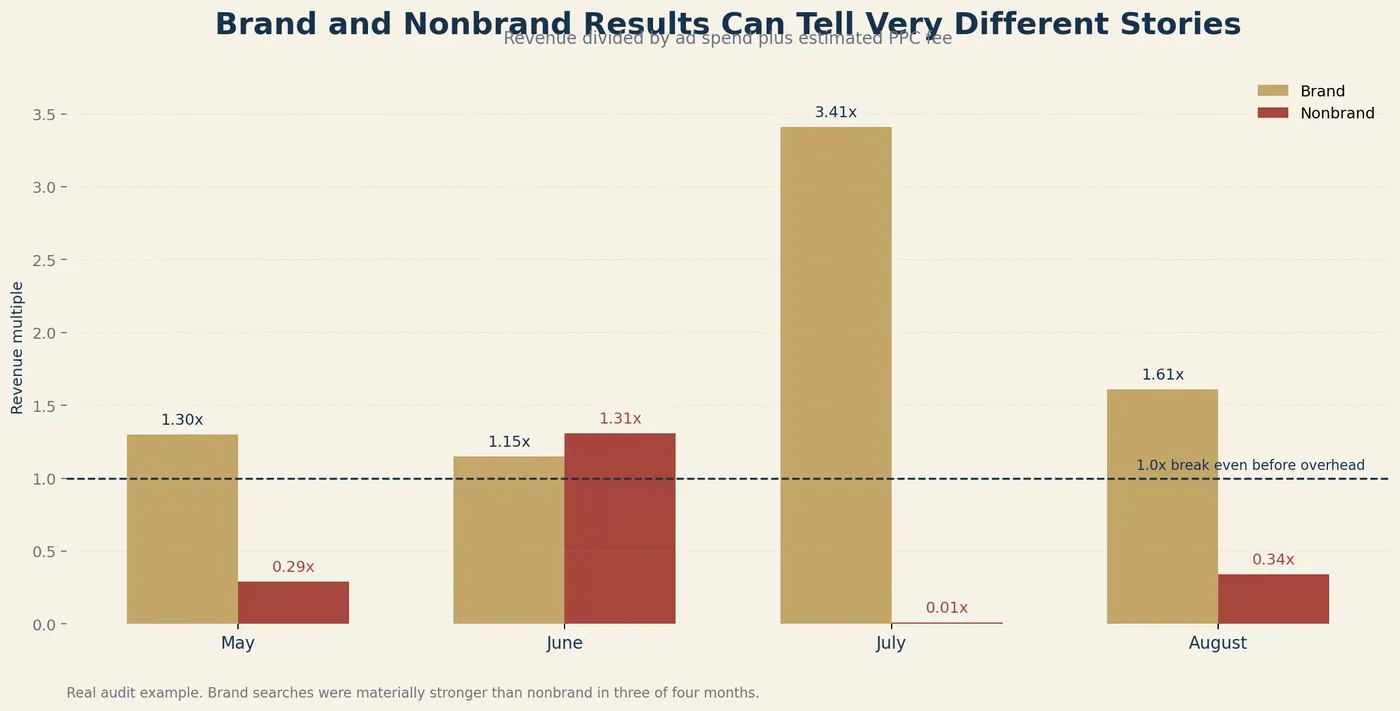
The same account showed a sharp difference between brand and nonbrand performance. This is the kind of split a top-line ROAS number can hide.
A useful monthly report should make those differences easier to understand, not harder. See What Should a Digital Marketing Agency Report Every Month?.
6. Website and conversion paths
Marketing does not stop when someone reaches the website. Landing pages, forms, calls to action, mobile usability, page speed, navigation, message clarity, and conversion friction can all affect whether paid or organic traffic becomes a lead.
A marketing channel can successfully bring the right person to the site and still look like it failed if the next step is confusing or difficult.
7. Internal marketing operations
Marketing audits are not only for companies using agencies. An internal marketing department audit can review priorities, budget allocation, channel mix, reporting, vendor management, processes, technology, campaign execution, and the connection between marketing activity and business results.
The purpose is not to grade employees. It is to give leadership an outside view of whether the current operation is focused on the right work and whether resources are being used effectively.
What should you receive at the end?
A real audit should leave you with something more useful than a score. You should understand what appears to be working, what needs attention, where money may be getting wasted, which findings materially affect performance, what cannot currently be verified, and what should happen next.
| Executive summary | The few findings leadership needs to understand first. |
| Documented findings | Evidence behind the issues, not just a list of opinions. |
| Priority issues | What matters now versus what can wait. |
| Cost and performance concerns | Where spend, performance, or reporting does not line up. |
| Questions for the agency or team | Specific items that need explanation or correction. |
| Recommended next steps | What to fix, verify, monitor, or leave alone. |
A free audit and an independent audit are not the same thing
There is nothing inherently wrong with a free account review. It can be useful. The important part is understanding the incentive behind it.
| Sales-led review | Independent audit |
|---|---|
| Often designed to identify services the provider can sell | Designed to evaluate what is actually happening |
| Usually centered on the seller’s specialty | Can review multiple channels, vendors, or internal teams |
| Often ends with a proposal | Can conclude that no major change is needed |
| May stay at the surface level | Scope can include underlying accounts and business data |
How much should a digital marketing audit cover?
There is no single correct scope. A business spending on one advertising channel does not need the same review as a company using multiple agencies, several ad accounts, an internal marketing team, and a complex CRM.
Scope should follow the business problem. Number of channels, vendors, accounts, historical data, website complexity, CRM setup, and the questions leadership needs answered all matter.
When does a marketing audit make sense?
- Marketing spend has increased without clear growth.
- Agency reports do not match internal results.
- Lead quality has declined.
- Leadership does not know which channels are producing customers.
- SEO activity is difficult to verify.
- Several vendors appear to be taking credit for the same results.
- The business inherited an existing marketing setup.
- Management wants an independent review before changing agencies, budgets, or strategy.
The bottom line
A digital marketing audit service should do more than point out technical imperfections. It should help leadership answer practical questions: Where is the money going? What is producing meaningful results? Can the reporting be trusted? What deserves attention first? And, where the data allows it, how does the marketing connect to actual business outcomes?
More insights
Do not have time to investigate all of this yourself?
Marketing Audit Co. independently reviews the accounts, reporting, spend, execution, and available business results and shows you what deserves attention.